Police–bus pursuit
trackDrone tracks a bus from 40 meters and radios the ego when a police car chases the bus through an intersection.
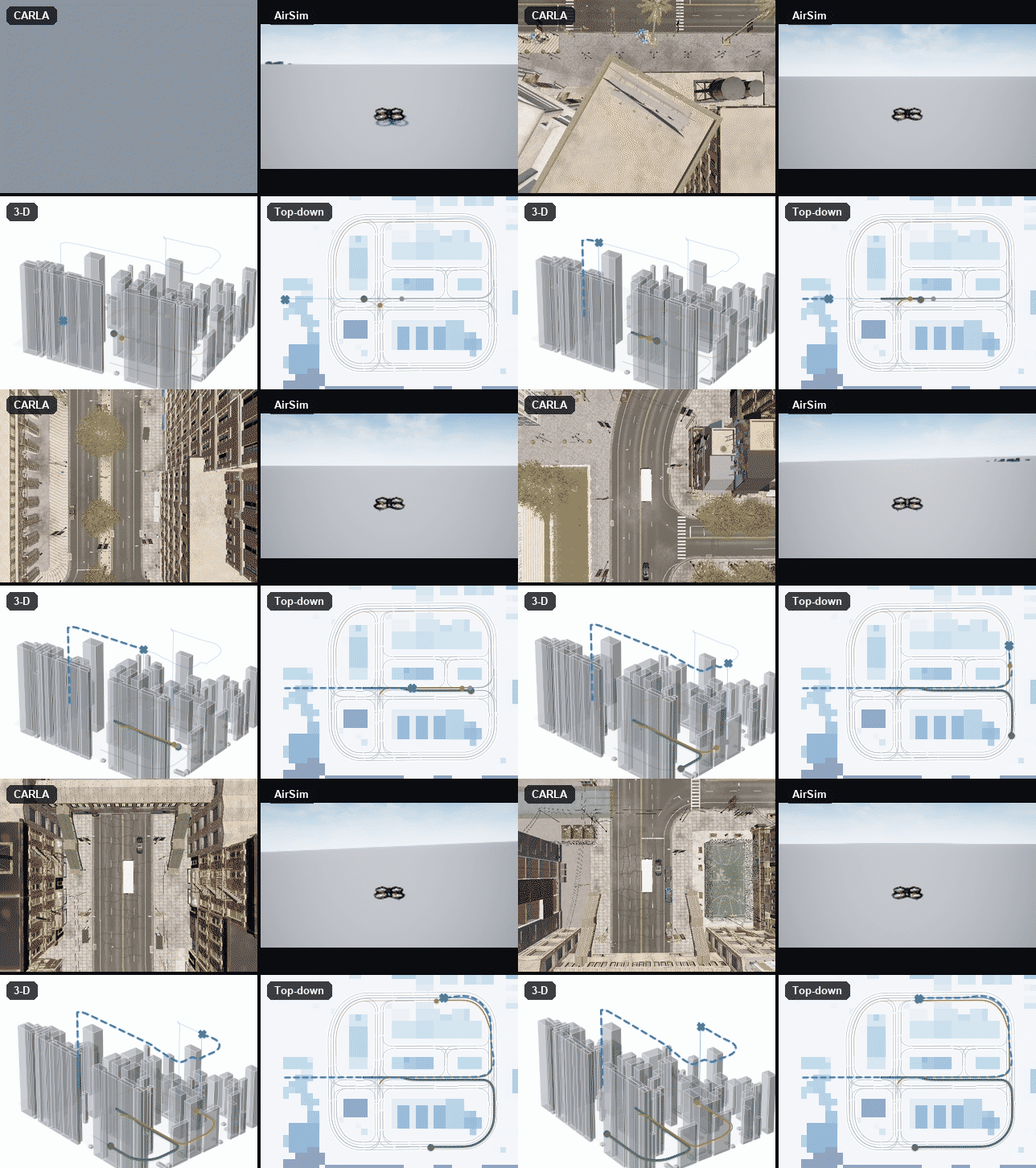
A trigger the prompt only implies, synthesized by the planner and then checked against when it fired.
arXiv:2609.19527
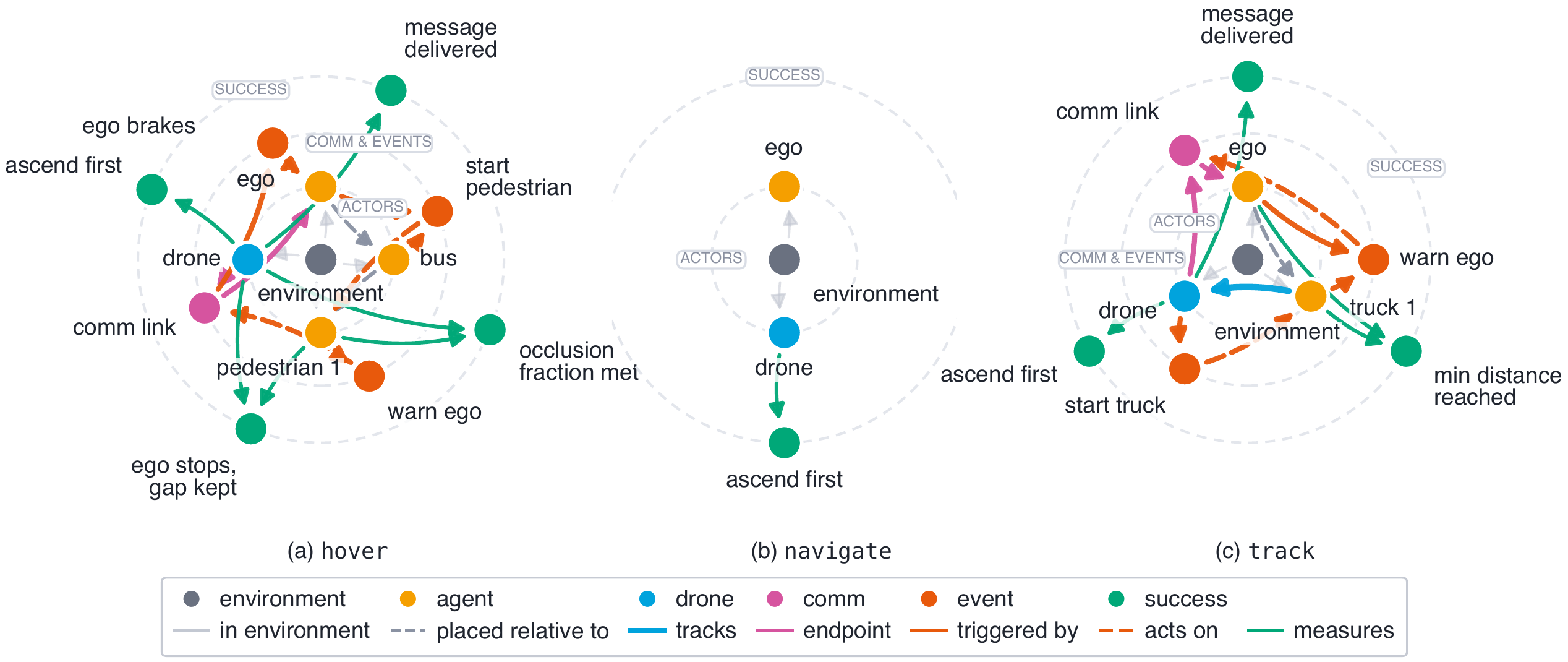
The prompt picks one mission — hover, track, or navigate; the climb and landing come with it. A vocabulary that small gives every phase a predicate to enter, a monitor to check, and a parameter to repair.

Six prompts, compiled and executed. Each clip shows one run four ways, on one clock.
Drone tracks a bus from 40 meters and radios the ego when a police car chases the bus through an intersection.
A trigger the prompt only implies, synthesized by the planner and then checked against when it fired.
A van drives ahead of the ego car and a police follows behind it while two background cars circulate; a drone tracks the van from 35 meters.
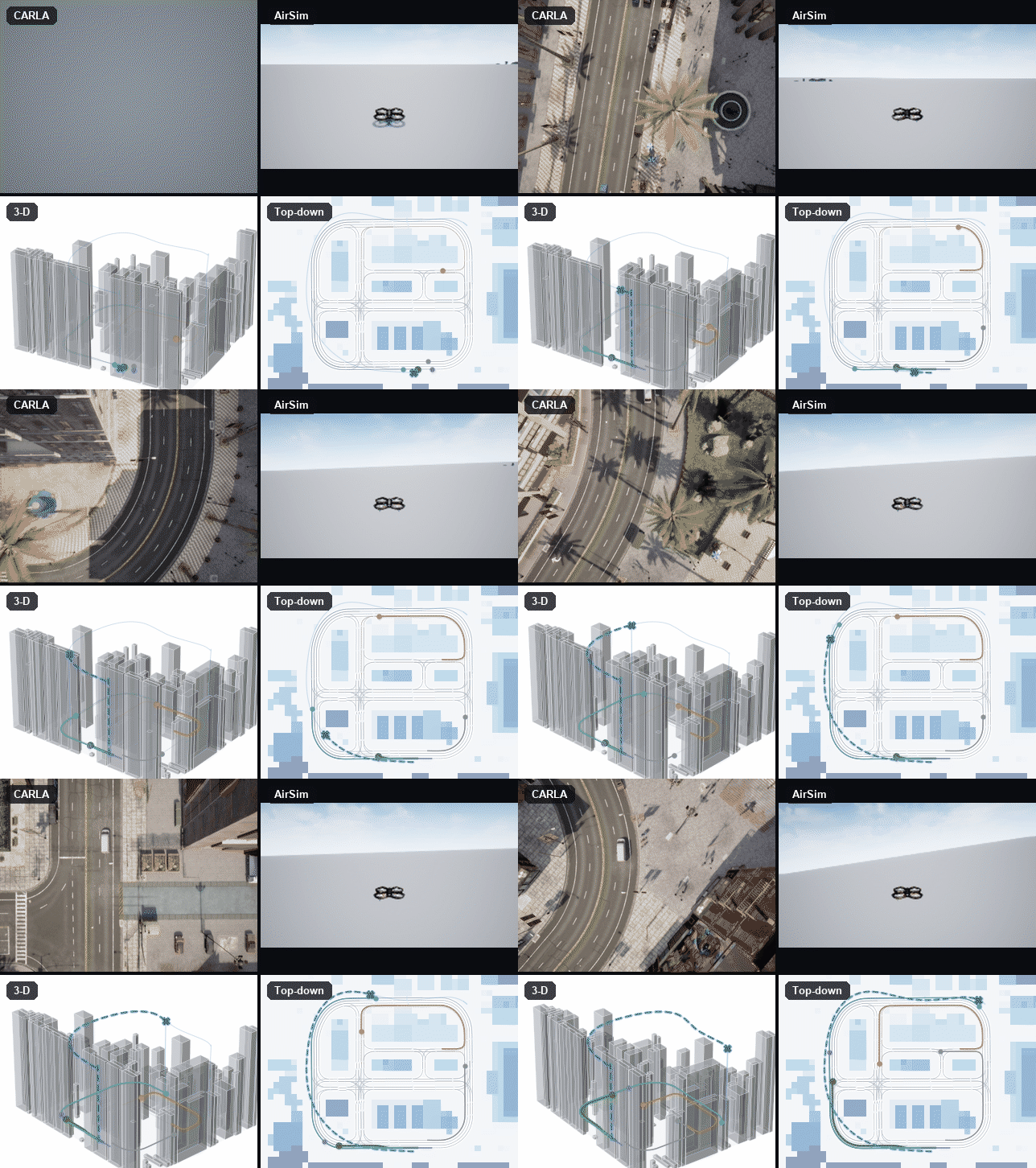
Four coupled agents and an aerial follower — the case that presses on the 8.6 m/s flight ceiling.
A drone ascends to 25 meters and then follows a truck as it drives through the streets.
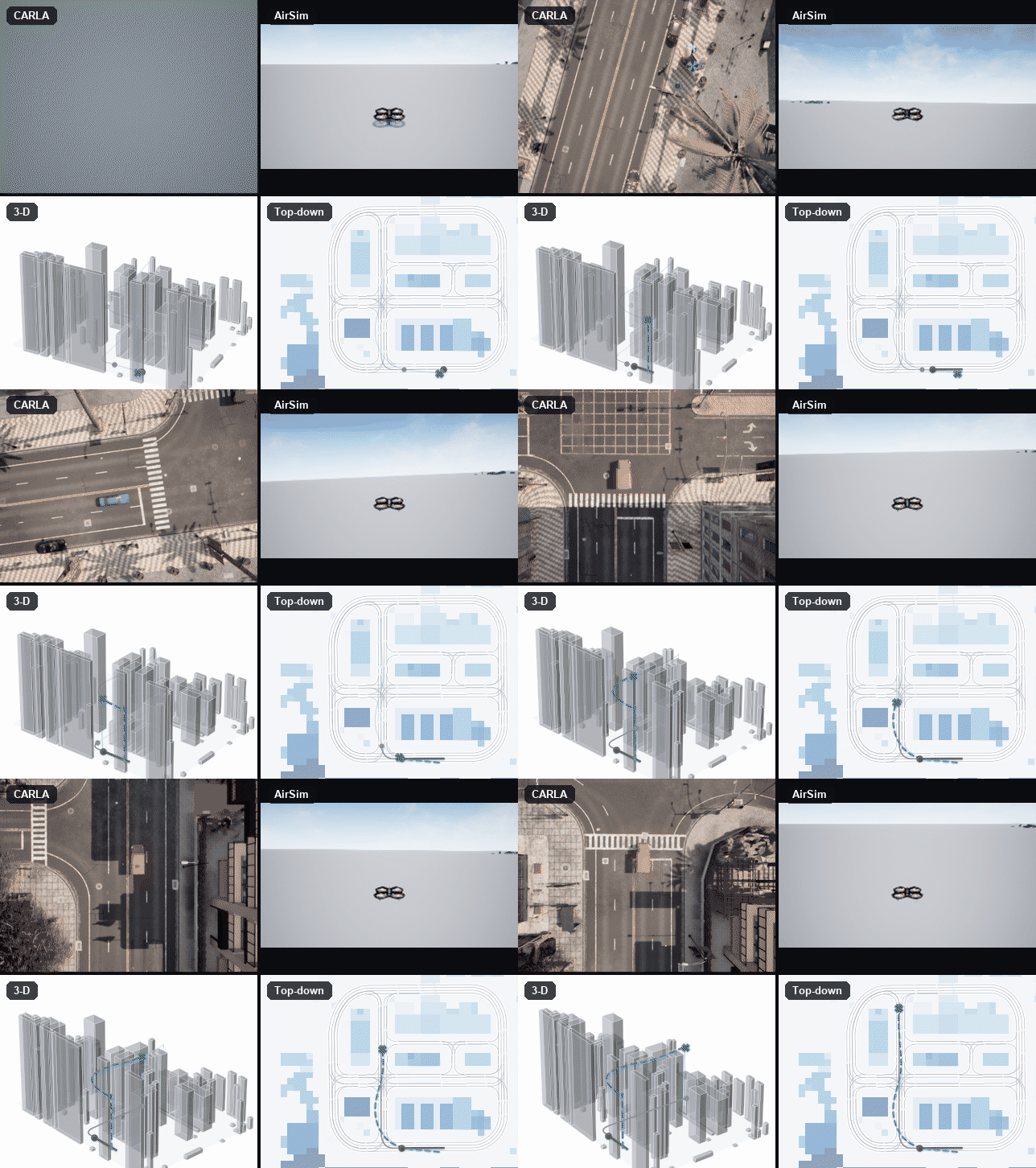
“Then” is a gate, not a hint: tracking cannot begin before the climb completes, and the monitor checks that order on the trace.
A parked truck hides a pedestrian, who starts crossing; a hovering drone spots the pedestrian and warns the ego, which then brakes.
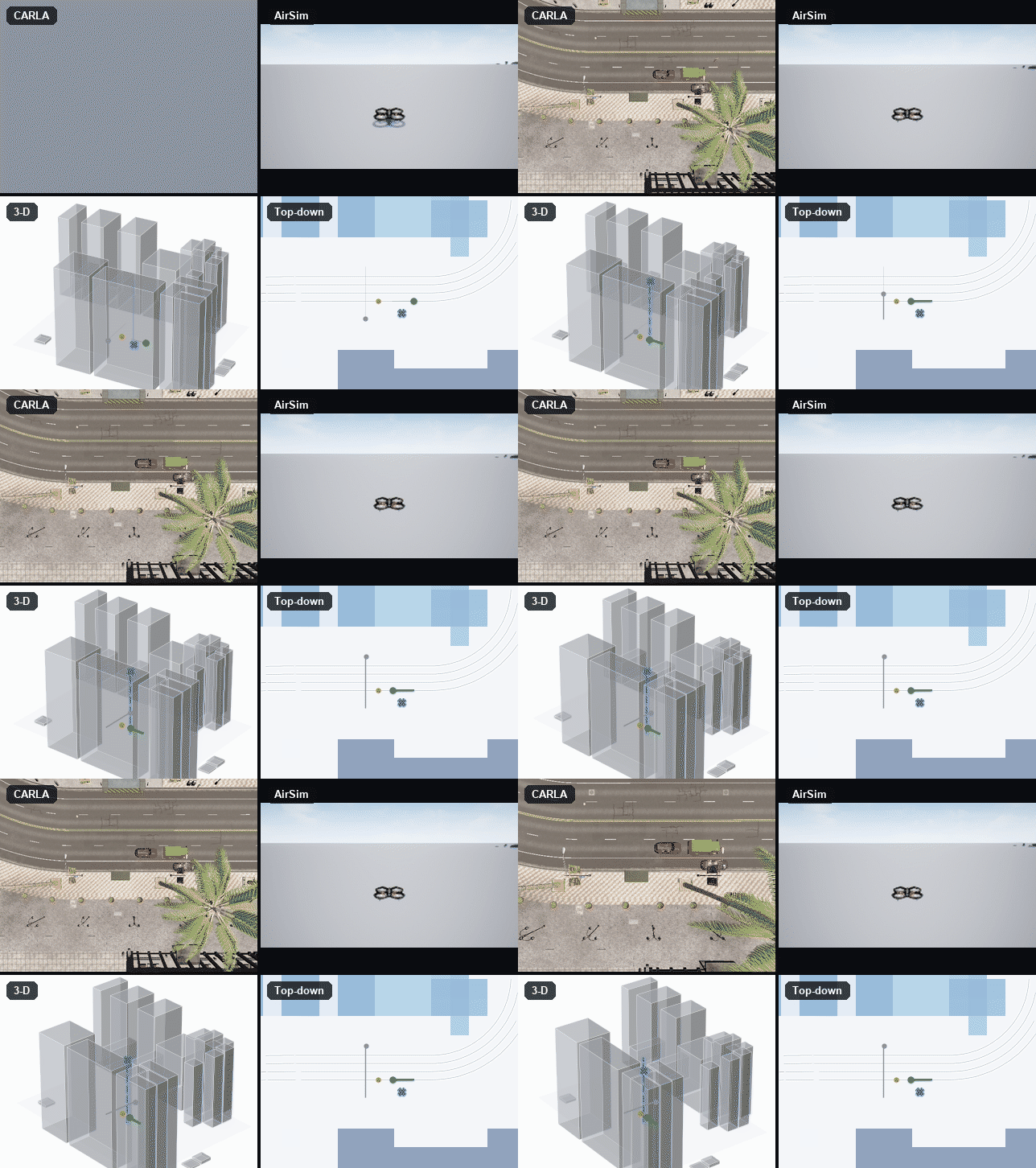
The truck hides the pedestrian for 77% of the crossing; the drone keeps 98% visibility. The warning lands 200 ms after detection; the ego stops 9.1 m short.
In clear weather at midday, a drone flies a rectangular survey route at 30 meters altitude over the streets around the ego car.
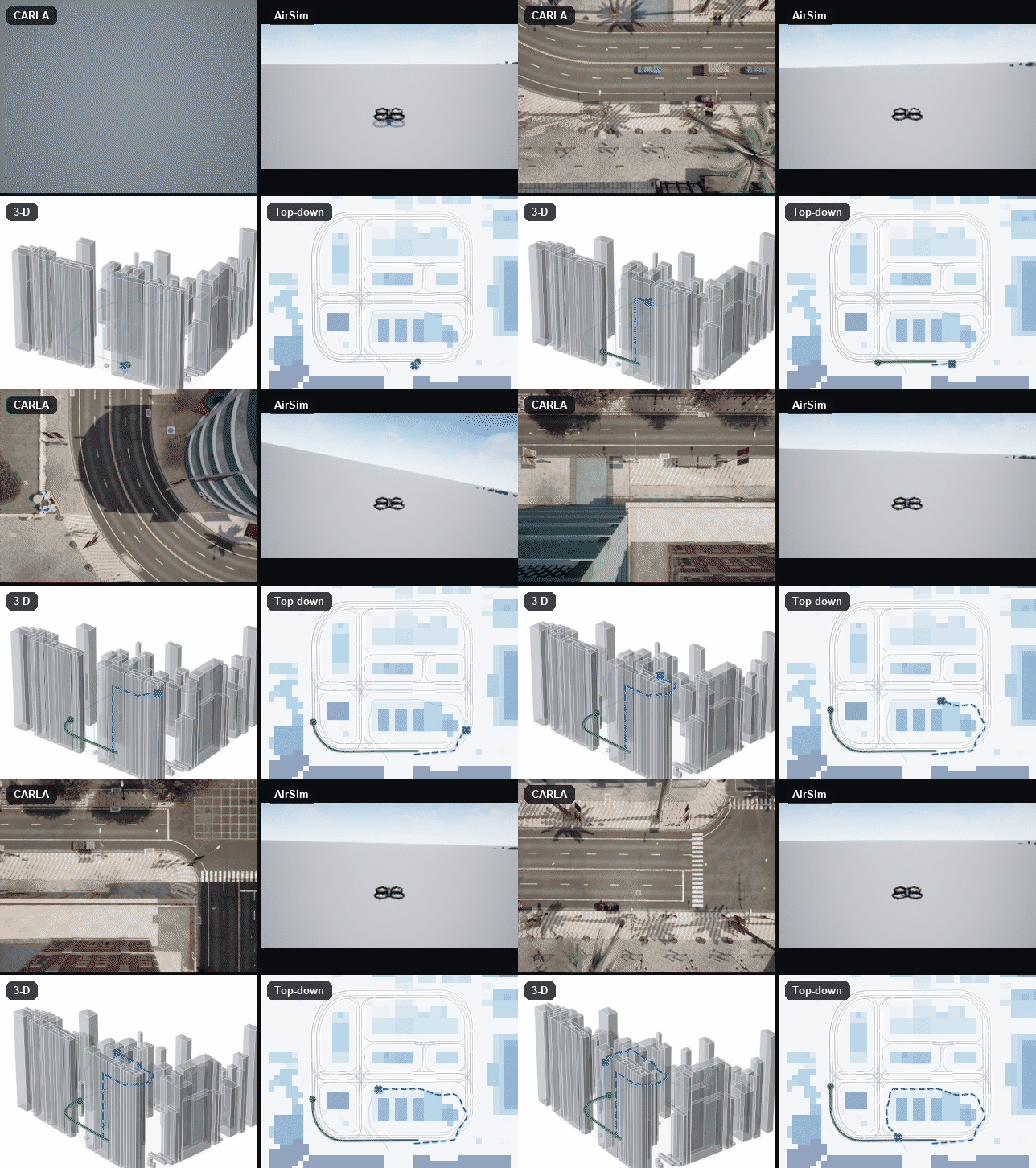
Waypoints that fall inside buildings are snapped to clear airspace before routing, so the route flies at the altitude asked for.
In wet roads at night, a drone flies a rectangular survey route at 40 meters altitude over the streets around the ego car.
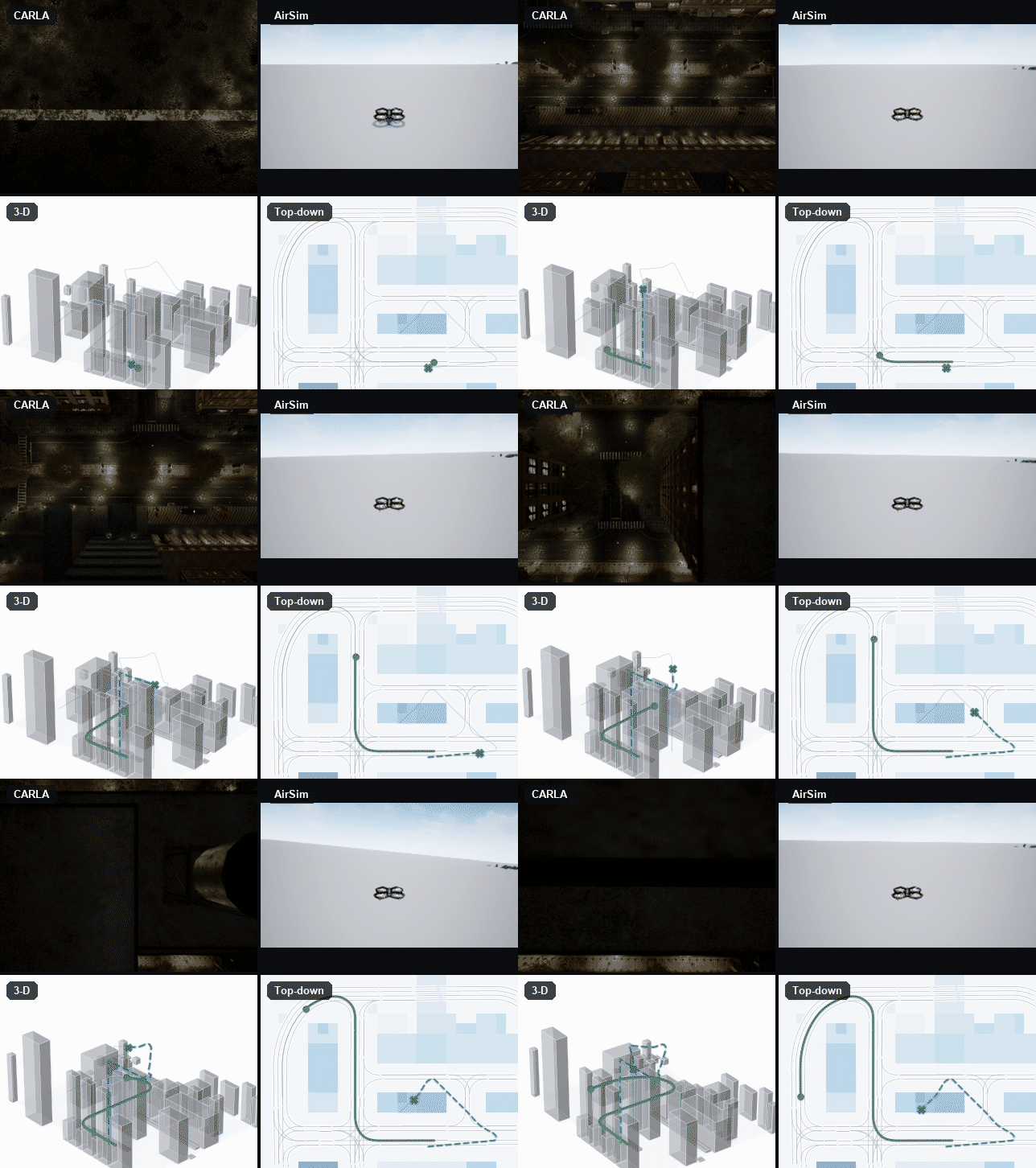
Weather and time of day are requirements like any other — wet roads, night, 40 m — set from the prompt and scored one by one.
Language-driven air–ground simulation, recast as verified compilation.
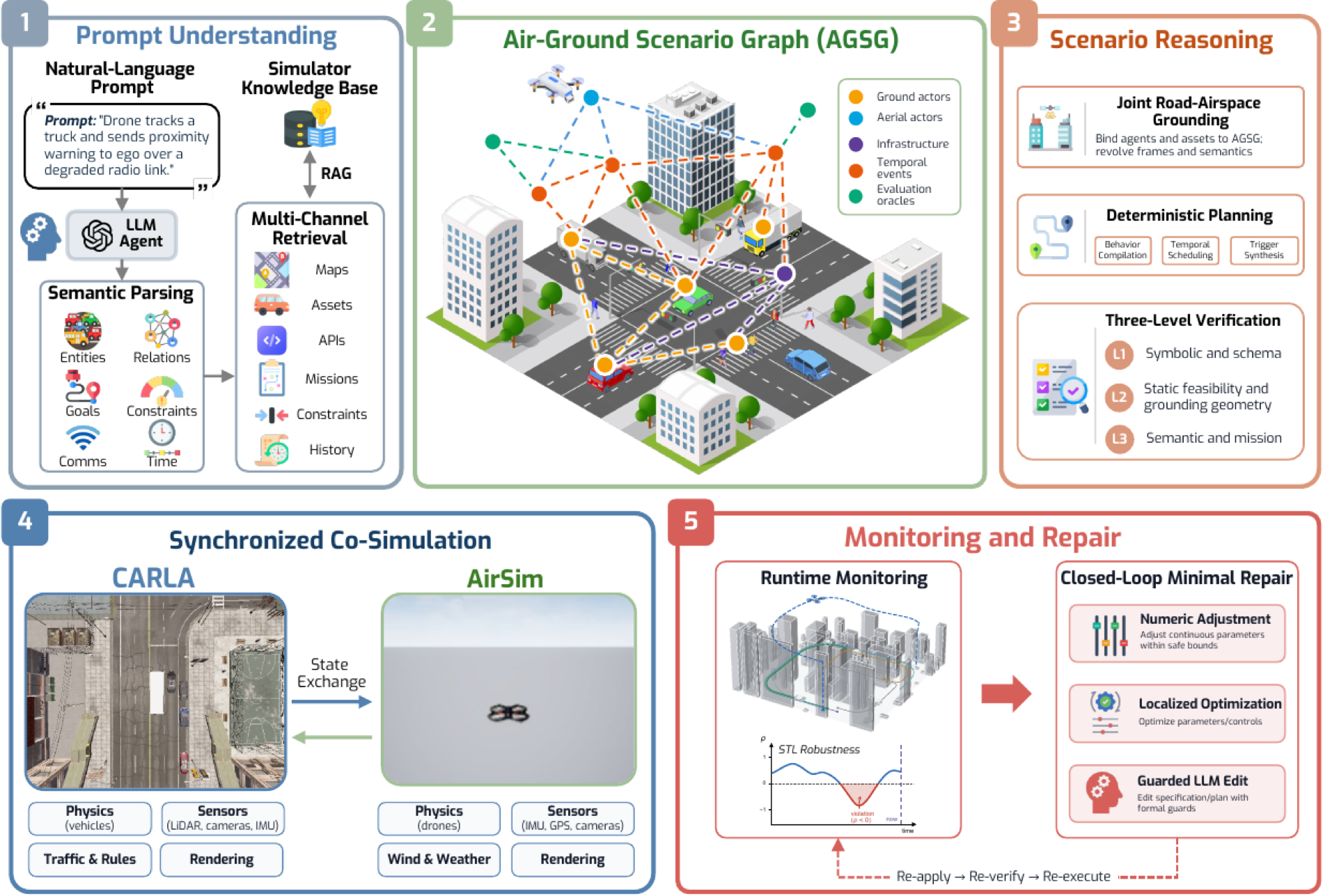
Five stages, one rule for which of them the language model may touch.
Free text is decoded into a typed language, retrieval-augmented (RAG) over a knowledge base built by measuring the simulators, not by reading documentation about them.
Where the scenario can exist, when its events fire, whether its requirements are satisfiable at all — each answered by construction, not sampling.
Both simulators advance under a shared logical clock, trace monitors score the outcome, and a bounded repair ladder — numeric adjustment, localized optimization, guarded language-model edit — touches only the parameters that could have caused the violation.
One object for every downstream stage to quantify over.
One prompt through every representation the pipeline produces: language, graph, plan, execution, measurement.
Aggregate metrics hide the difference between a scenario that satisfied its criteria and one that satisfied them for the wrong reason. Every execution therefore archives a full artifact set — specification, grounded graph, per-tick trace, frames, renderings, timelines — and every number traces back to it.
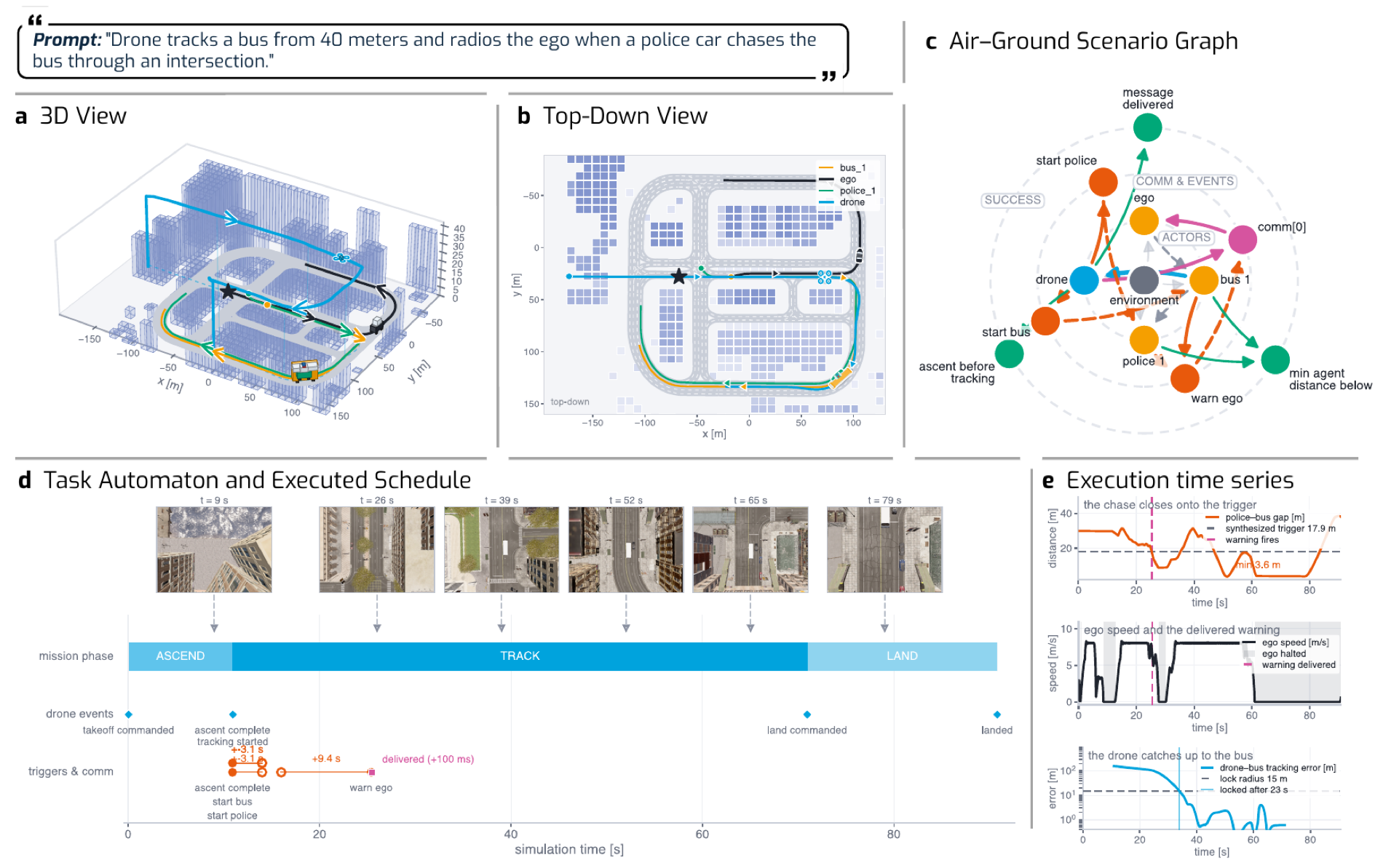
The warning reaches the ego vehicle before the drone establishes close tracking. That ordering is the whole argument for separating communication from mission performance: a delivered message does not establish sustained tracking, and a single completion label would collapse the two. Requirement-level monitoring keeps them apart, and the graph then says which components to look at when one of them is unmet.
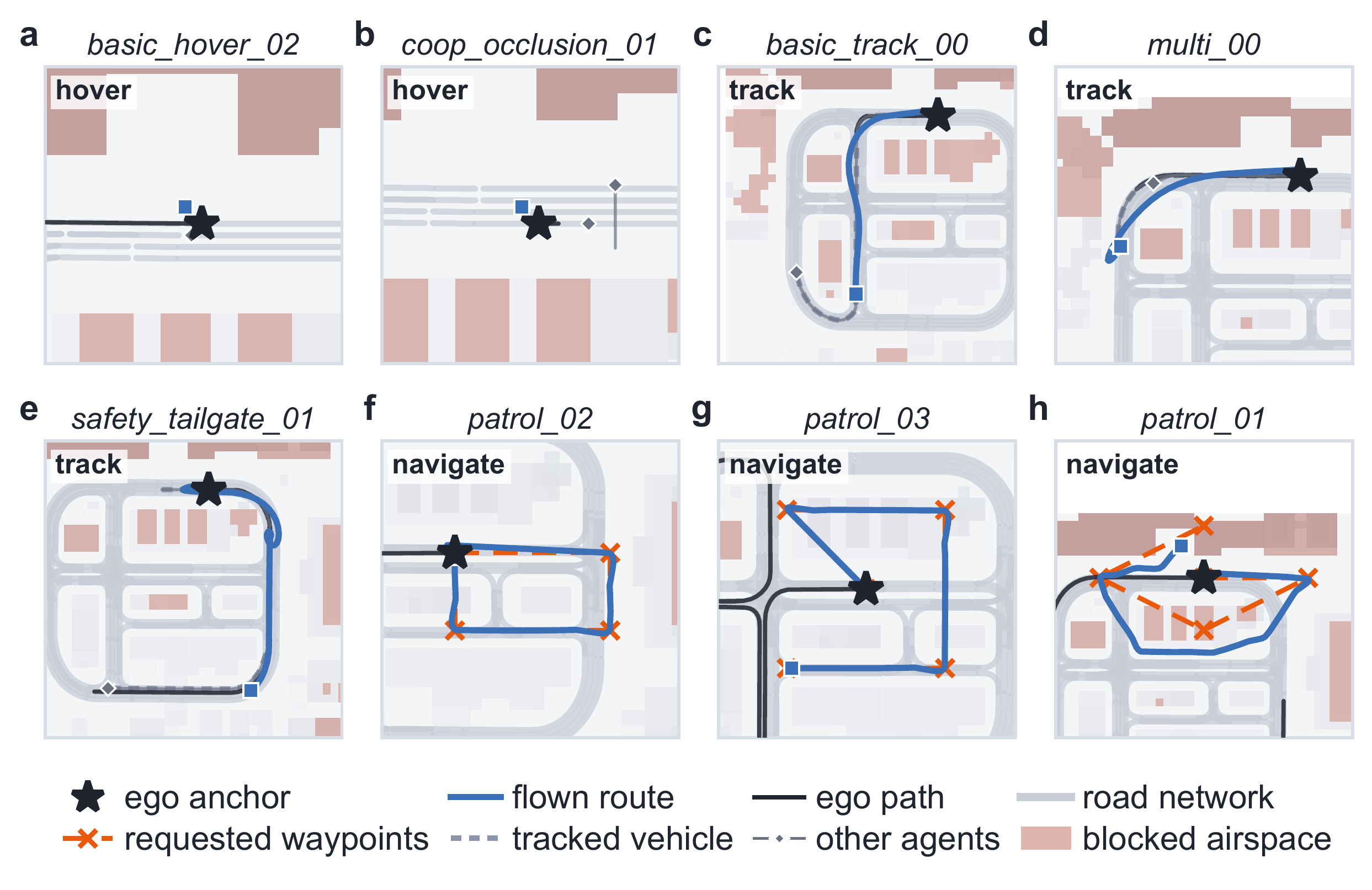
In clear weather at midday, a drone flies a rectangular survey route at 30 meters altitude over the streets around the ego car.

A drone ascends to 40 meters and then follows a motorcycle as it drives through the streets.

A bus drives ahead of the ego car and an ambulance follows behind it while two background cars circulate; a drone tracks the bus from 35 meters.

A van tailgates the ego car closely, closing from 45 meters; a tracking drone alerts the ego when the van comes within 20 meters.

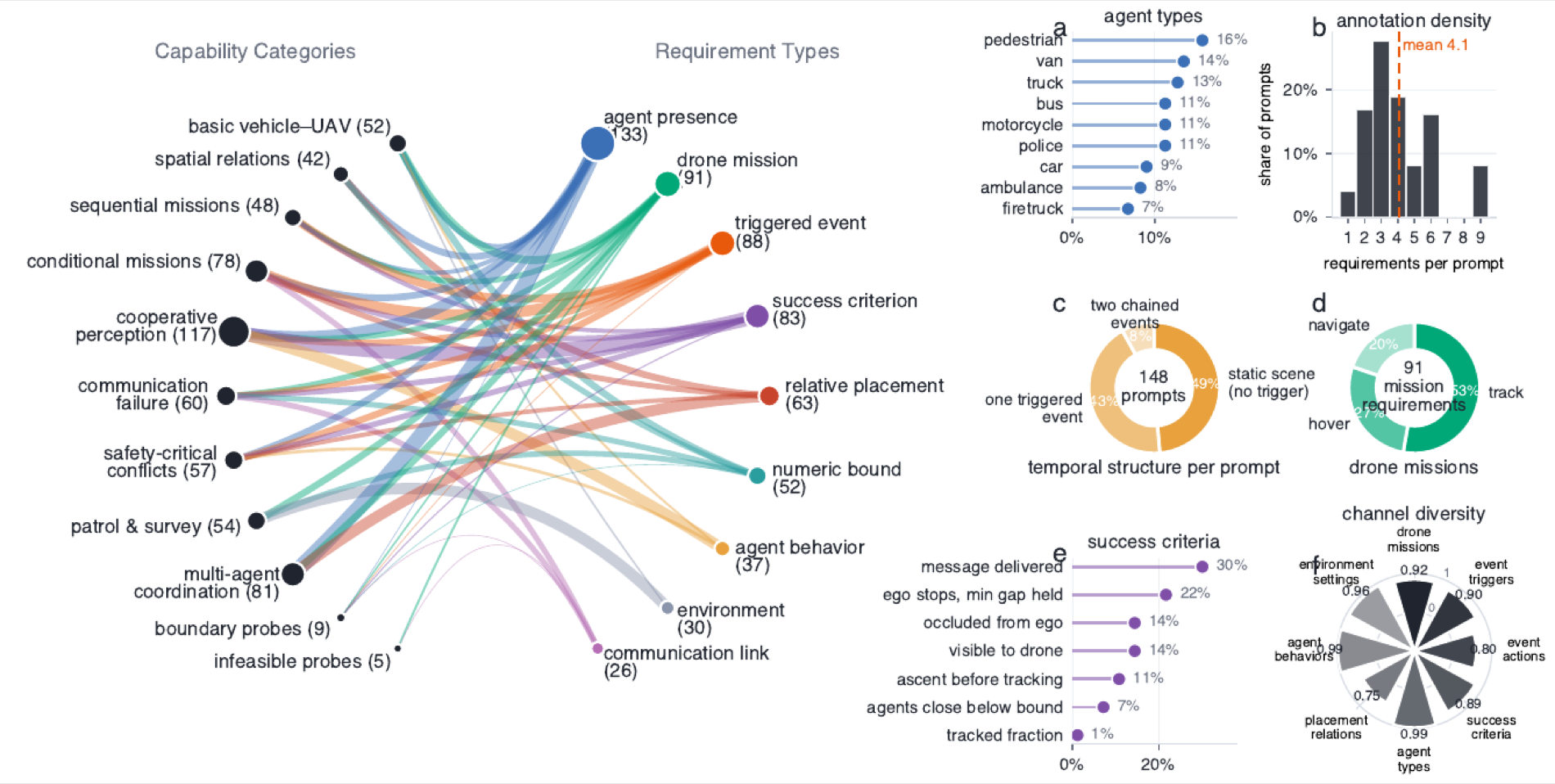
200 prompts, 904 checkable requirements, probes on both sides of feasibility.
Six configurations, five language models, three questions kept apart: does it run, does it preserve the request, does it realize it?
The ladder adds one component at a time — direct code generation (B1), simulator documentation (B2), simulator-grounded retrieval (B3), the typed AGSG and managed executor (B4), static verification (B5), and runtime monitoring with localized repair (AURORA). B1–B3 emit code but no executable specification, so they can be scored for completion and never for realization: their successful runs are completed-unverifiable.
| Configuration | GPT-4o | GPT-5.5 | GPT-5.4-mini | Gemini 3.1 Pro | Gemini 3.8 Flash | ||||||||||||||||||||
|---|---|---|---|---|---|---|---|---|---|---|---|---|---|---|---|---|---|---|---|---|---|---|---|---|---|
| Method | C.↑ | RF↓ | P↑ | SF↓ | Fid.↑ | C.↑ | RF↓ | P↑ | SF↓ | Fid.↑ | C.↑ | RF↓ | P↑ | SF↓ | Fid.↑ | C.↑ | RF↓ | P↑ | SF↓ | Fid.↑ | C.↑ | RF↓ | P↑ | SF↓ | Fid.↑ |
| B1: Direct code generation | 0.42 | 0.58 | — | — | — | 0.82 | 0.18 | — | — | — | 0.70 | 0.30 | — | — | — | 0.80 | 0.20 | — | — | — | 0.72 | 0.28 | — | — | — |
| B2: + Documentation | 0.68 | 0.32 | — | — | — | 0.92 | 0.08 | — | — | — | 0.86 | 0.14 | — | — | — | 0.94 | 0.06 | — | — | — | 0.92 | 0.08 | — | — | — |
| B3: + Grounded retrieval | 0.66 | 0.34 | — | — | — | 0.92 | 0.08 | — | — | — | 0.78 | 0.22 | — | — | — | 0.98 | 0.02 | — | — | — | 0.98 | 0.02 | — | — | — |
| B4: + AGSG & executor | 1.00 | 0 | 0.58 | 0.42 | 0.966 | 1.00 | 0 | 0.42 | 0.58 | 1.000 | 1.00 | 0 | 0.50 | 0.50 | 1.000 | 1.00 | 0 | 0.66 | 0.34 | 0.993 | 1.00 | 0 | 0.62 | 0.38 | 0.984 |
| B5: + Static verification | 0.98 | 0 | 0.56 | 0.42 | 0.980 | 1.00 | 0 | 0.48 | 0.52 | 1.000 | 1.00 | 0 | 0.60 | 0.40 | 0.995 | 0.98 | 0 | 0.70 | 0.28 | 0.995 | 1.00 | 0 | 0.54 | 0.46 | 0.971 |
| AURORA | 0.98 | 0 | 0.76 | 0.22 | 0.980 | 1.00 | 0 | 0.64 | 0.36 | 1.000 | 1.00 | 0 | 0.70 | 0.30 | 0.995 | 0.98 | 0 | 0.84 | 0.14 | 0.995 | 1.00 | 0 | 0.74 | 0.26 | 0.971 |
End-to-end performance, 50-prompt subset. C. completion · RF runtime failure · P verified pass · SF silent failure · Fid. prompt fidelity; best per column in accent. Completion below B4 is pre-execution rejection, not execution breakdown.
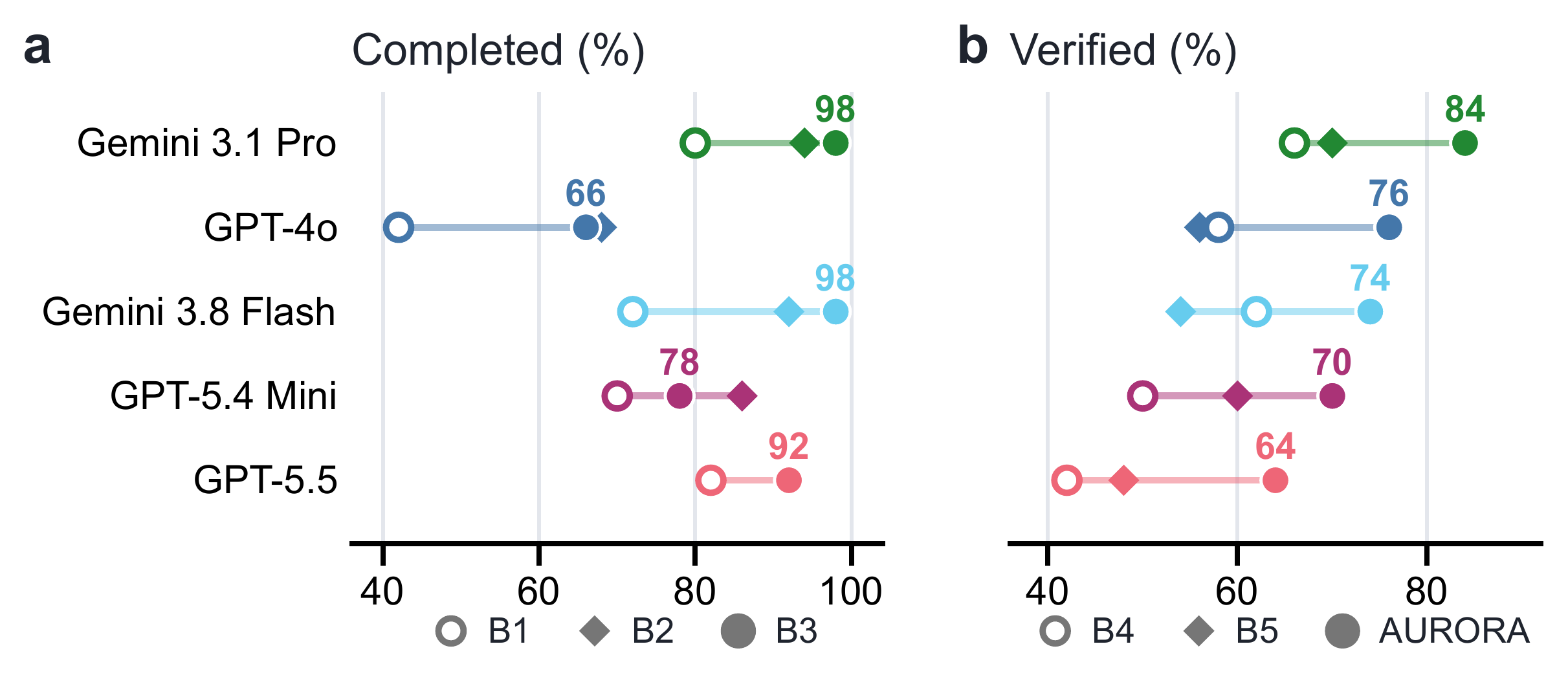
Simulator knowledge improves code execution but never eliminates runtime failure: documentation raises completion for all five models, retrieval adds mixed further gains. The decisive change is structural. Introducing the typed AGSG and managed executor takes completion to 100% and removes observed runtime failures across every model — and leaves 34–58% of scenarios silently failing, complete and wrong. Completion alone therefore cannot evaluate a generated scenario.
Runtime feedback supplies the gain that structure does not. Static verification alone shifts verified pass only unevenly, because finding a feasible configuration before execution does not make a trace-dependent requirement hold during it. Adding runtime monitoring and localized repair improves verified pass by 10–20 percentage points over B5 across all five models, reaching 64–84%. Fidelity is unchanged from B5 to AURORA for every model, so the gain does not come from a broad relaxation of what was asked — though individual edits still warrant inspection when they touch thresholds.
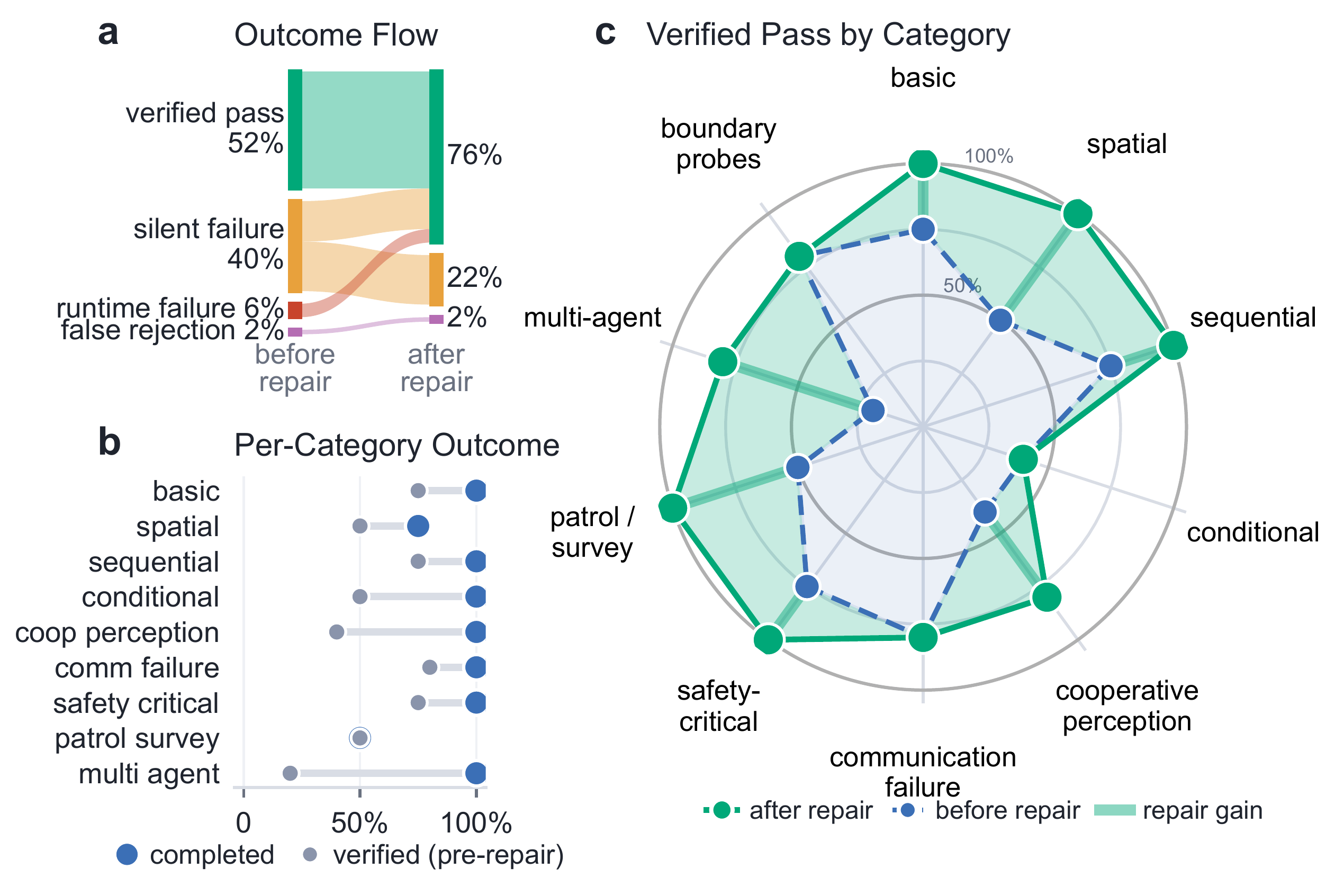
Repair routes each violation to the stage that can fix it — the two cases above show the split: a quantitative margin goes to the repair loop, a structurally infeasible route back to grounding. Neither path regenerates the whole scenario.
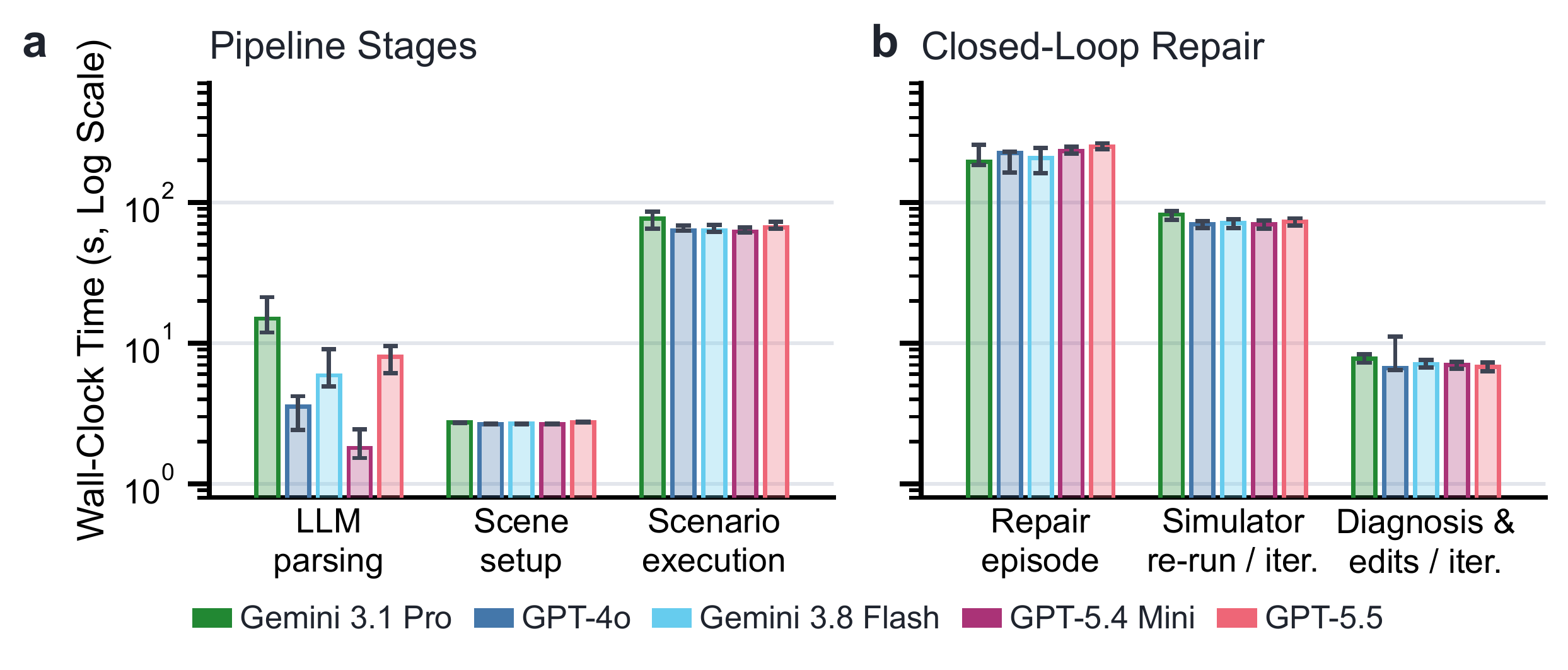
The cost is dominated by the simulator, not the model. Median repair episodes take 194–249 s, almost all of it repeated co-simulation; diagnosis and edit generation contribute little, and static checks and kinematic preview are close to free. The way to make repair cheaper is to avoid re-execution, not to accelerate edit generation.
Parsing can reinterpret an infeasible request, and repair can relax a monitored threshold; provenance weighting discourages both without prohibiting them. Read the verified-pass rate alongside prompt fidelity and the edit history — which is why every repair is logged.
@article{wu2026aurora,
  title={AURORA: A Natural Language-Driven Agentic Framework for Understanding, Reasoning, and Orchestrating Reliable Air-Ground Co-Simulation},
  author={Wu, Keshu and Zhang, Hao and Gan, Rui and Gao, Xiangbo and Li, Xiaopeng and Tu, Zhengzhong and Zhou, Yang},
  journal={arXiv preprint arXiv:2609.19527},
  year={2026}
}
Preprint: arXiv:2609.19527 · PDF