V2X Safety Testing · Large Language Models · CARLA

LAST-V2X

Language-Driven Adaptive Scenario Synthesis and Testing for Communication-Induced Failures in V2X Safety Applications

Keshu Wu1,2 Hao Zhang1 Rui Gan2 Pei Li3 Jiwan Jiang1 Yang Zhou1

1Texas A&M University 2University of Wisconsin-Madison 3University of Wyoming

arXiv soon Code soon
intent.txt spec.json LLM parser · AoI verifier
compiled specification
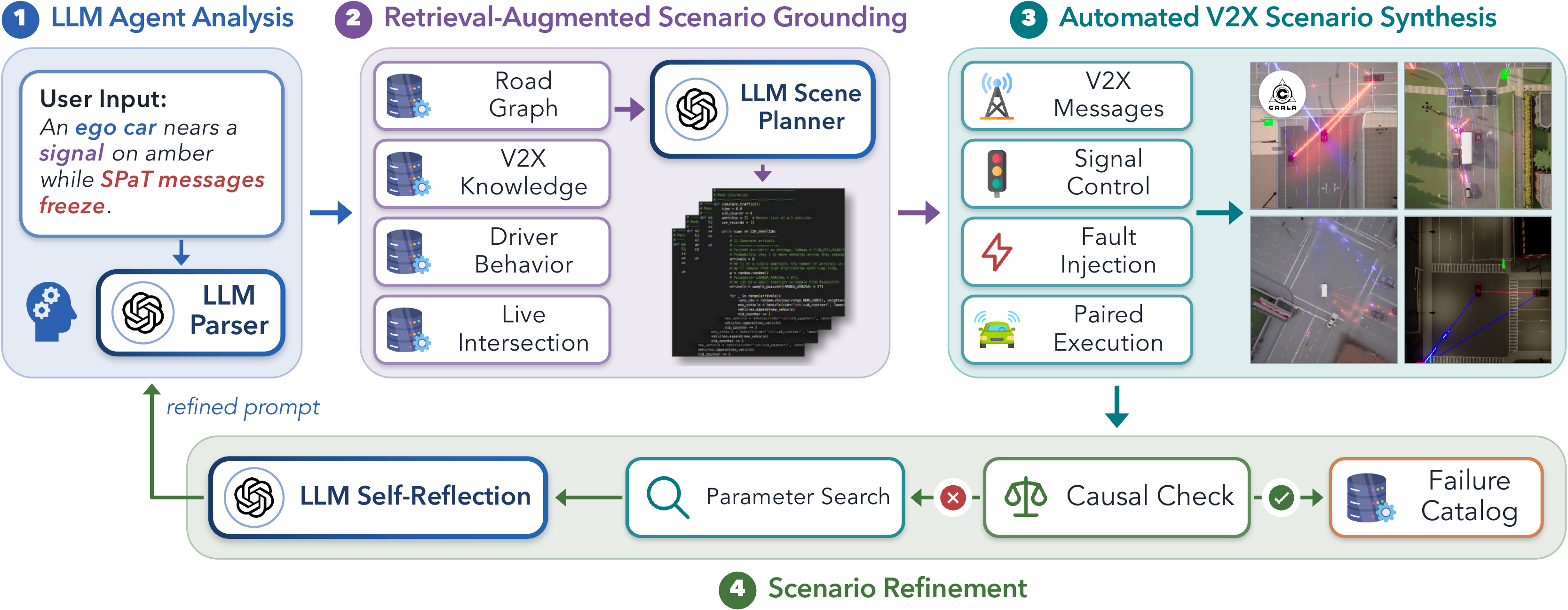
    Overview of LAST-V2X: LLM agent analysis, retrieval-augmented scenario grounding, automated V2X scenario synthesis, and scenario refinement with a causal check, parameter search, LLM self-reflection, and a failure catalog.
    Figure 1. Overview of LAST-V2X: four modules from a natural-language intent to a causally verified failure.

    Describe a V2X test in plain language. LAST-V2X builds it in CARLA, corrupts the messages, and keeps a failure only if the bad information caused it.

    100 language-driven scenes
    8 towns · 6 V2X apps
    0 spurious failures under
    healthy communication
    7→32 verified failures of 50
    after refinement
    60→1 alarms with matched
    twin rollouts

    1The idea

    The car never sees the world. It sees messages.

    Every V2X decision runs on a belief rebuilt from messages. A failure can come in anywhere along this chain.

    WorldW
    SampleΣ
    ChannelΓ
    FaultsΦF
    Beliefβ
    Decisionπa
    Stale but detectable

    Loss or delay ages the data. The app can notice and fall back safely.

    Fresh but wrong

    The message looks current but is wrong. The vehicle trusts it.

    Silent by absence

    A conflicting vehicle never transmits, so the app cannot see it.

    2Method

    One prompt in, one minimal failure out

    The LLM interprets the prompt. Fixed rules check feasibility and decide whether a failure counts.

    1. I

      LLM Agent Analysis

      Parses the prompt into a typed spec. An Age-of-Information check rejects faults that cannot matter.

    2. II

      Scenario Grounding

      Retrieves road, V2X and driver knowledge. The planner assigns agents to real lanes.

    3. III

      V2X Synthesis

      SPaT, MAP and BSM pass through a spatial channel and fault injection, next to a ground-truth twin.

    4. IV

      Refinement

      Search and LLM self-reflection repair weak tests. Delta debugging reduces each failure to one fault.

    3Paired rollout replay

    Same traffic, two egos, one difference

    The ego acts on received SPaT. Its twin acts on the true signal. A failure counts only if ego fails ∧ twin safe.

     
    EGO · acts on received SPaT true signal TWIN · acts on true signal (no physical presence) stop bar received Ego enters on red
    Signal
    Received
    t 0.0 s ego – m twin – m

    Trajectories follow the paper's rlvw_late_freeze case in CARLA. Distance is measured from the stop bar.

    4Test vocabulary

    Seven faults, six safety apps

    Each fault is tied to an event, such as amber onset or the ego reaching its decision point, so it hits exactly when it matters.

    Drdropskip k broadcasts
    Bdburst_dropbursty loss
    Dldelaylate delivery
    Skskewwrong timestamp
    Fzfreezestuck phase or track
    Rbrebindwrong signal group
    Pppos_perturbshifted BSM position
    Delivery Timestamp Semantic content
    Signal applications · I2V
    RLVW red-light violation GLOSA green-wave speed
    Conflict applications · V2V
    IMA crossing traffic LTA left turn FCW forward collision EEBL hard-brake relay

    5Results

    What the experiments show

    100 plain-language prompts compile, ground and run, with zero false failures.
    100/100 executed 365/367 clean spawns 0 false admissions
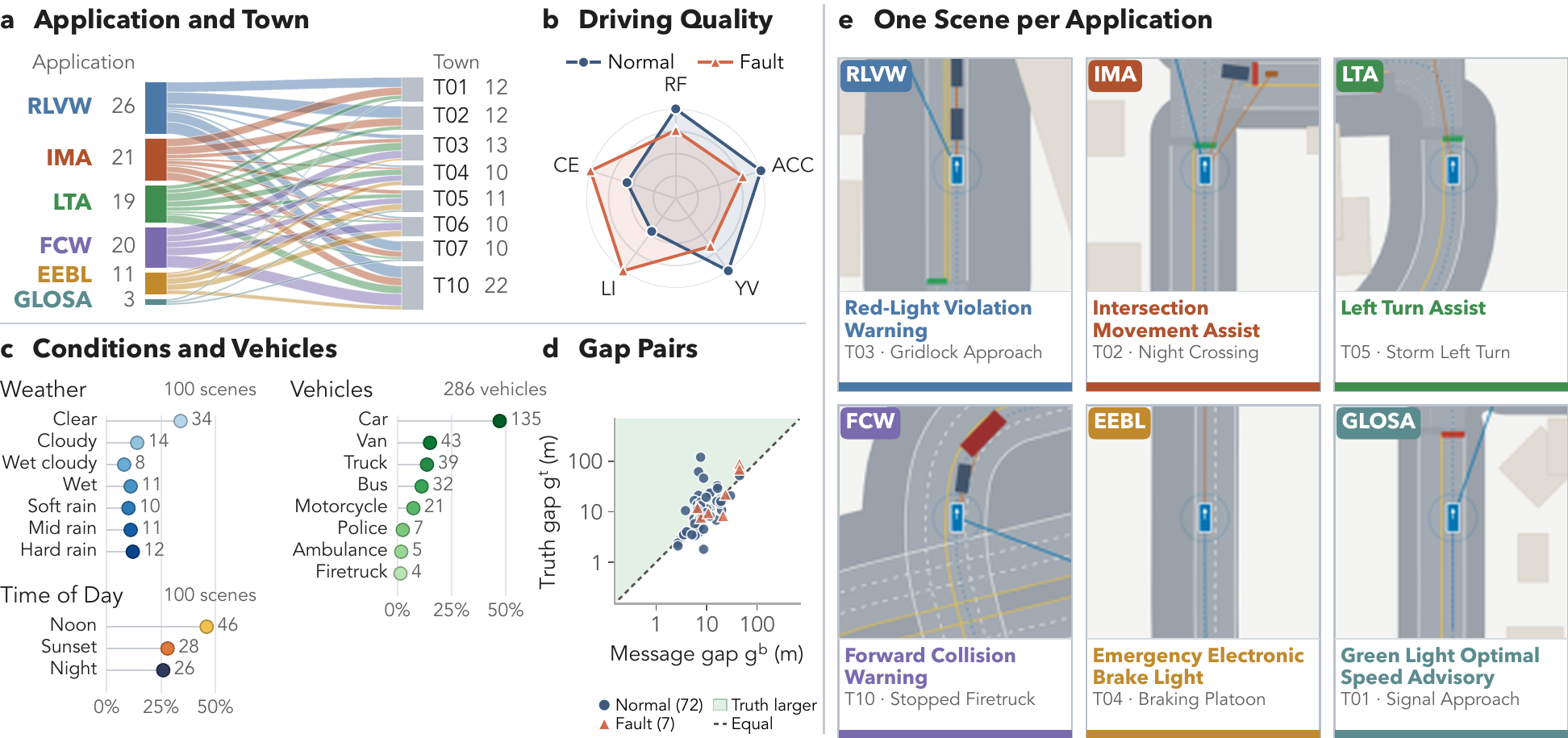
    Scenario generation over 100 scenes.
    Figure 2. Coverage, driving quality and message-driven vs. ground-truth gaps over 100 scenes.
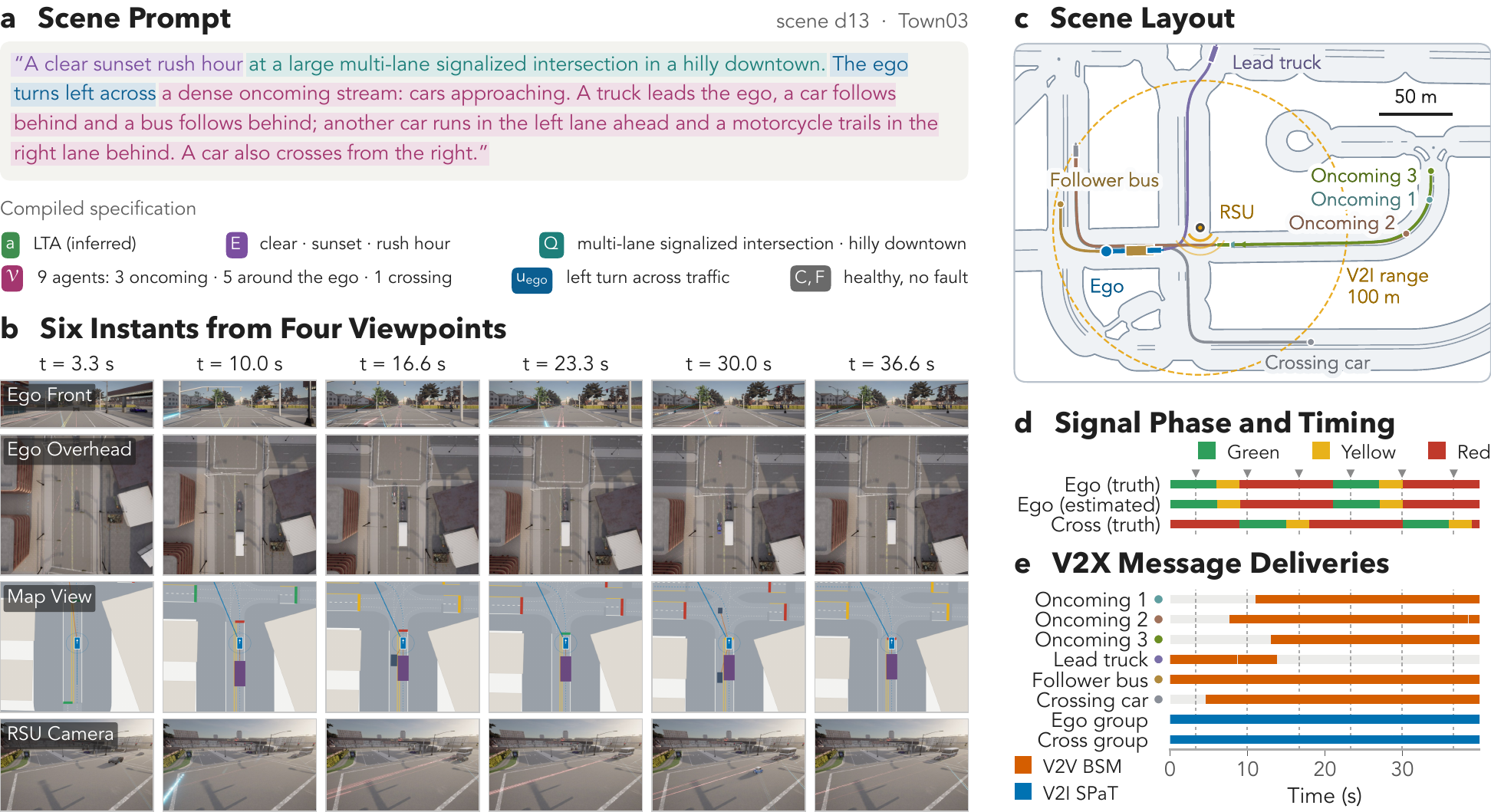
    A nine-agent left turn in Town03 under a healthy channel.
    Figure 3. A nine-agent left turn in Town03: prompt, four viewpoints, signal estimates and message deliveries.

    Search and self-reflection turn weak fault tests into verified failures.
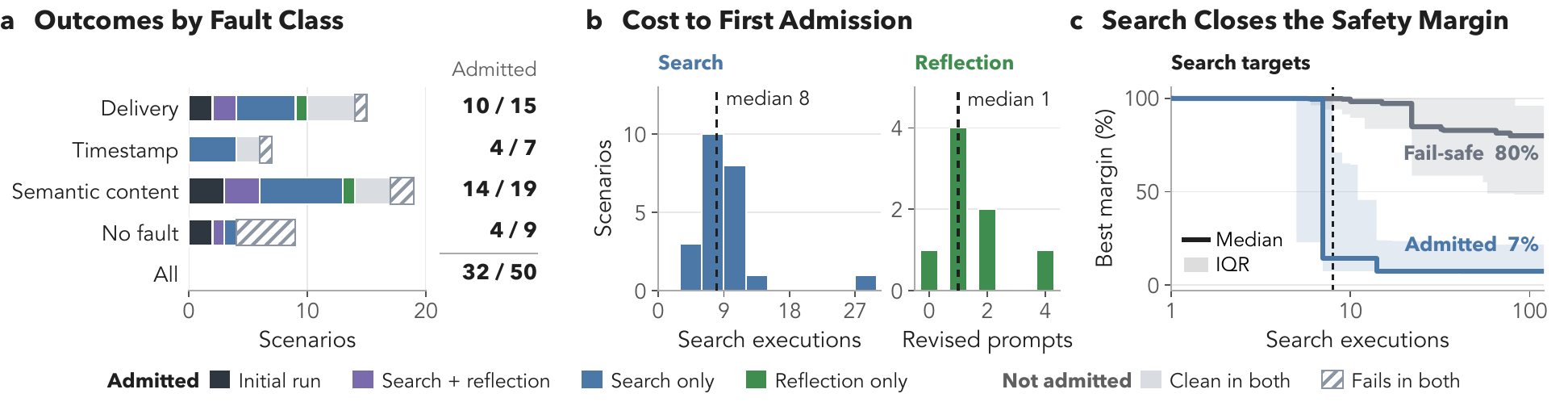
    7 → 32 of 50 admitted median 8 runs to first failure 8 rescued by reflection
    Scenario refinement on the 50-scene fault suite.
    Figure 4. Outcome by fault class, effort to first admission, and safety margin during search.
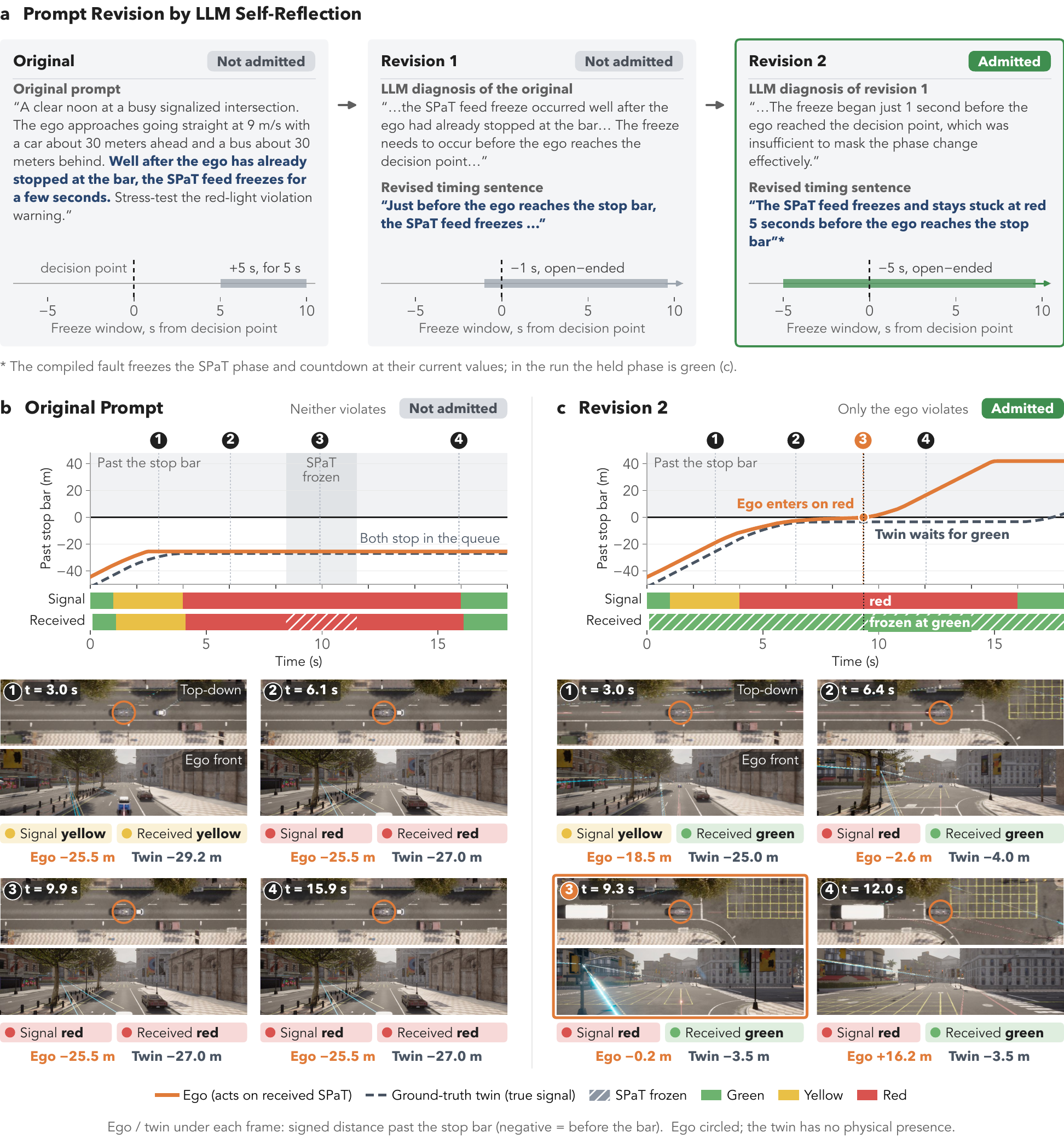
    Refinement example rlvw_late_freeze.
    Figure 5. rlvw_late_freeze: two rounds of reflection move the SPaT freeze in front of the decision point.

    An RSU relay chain lets the vehicle know about junctions beyond its own radio range.
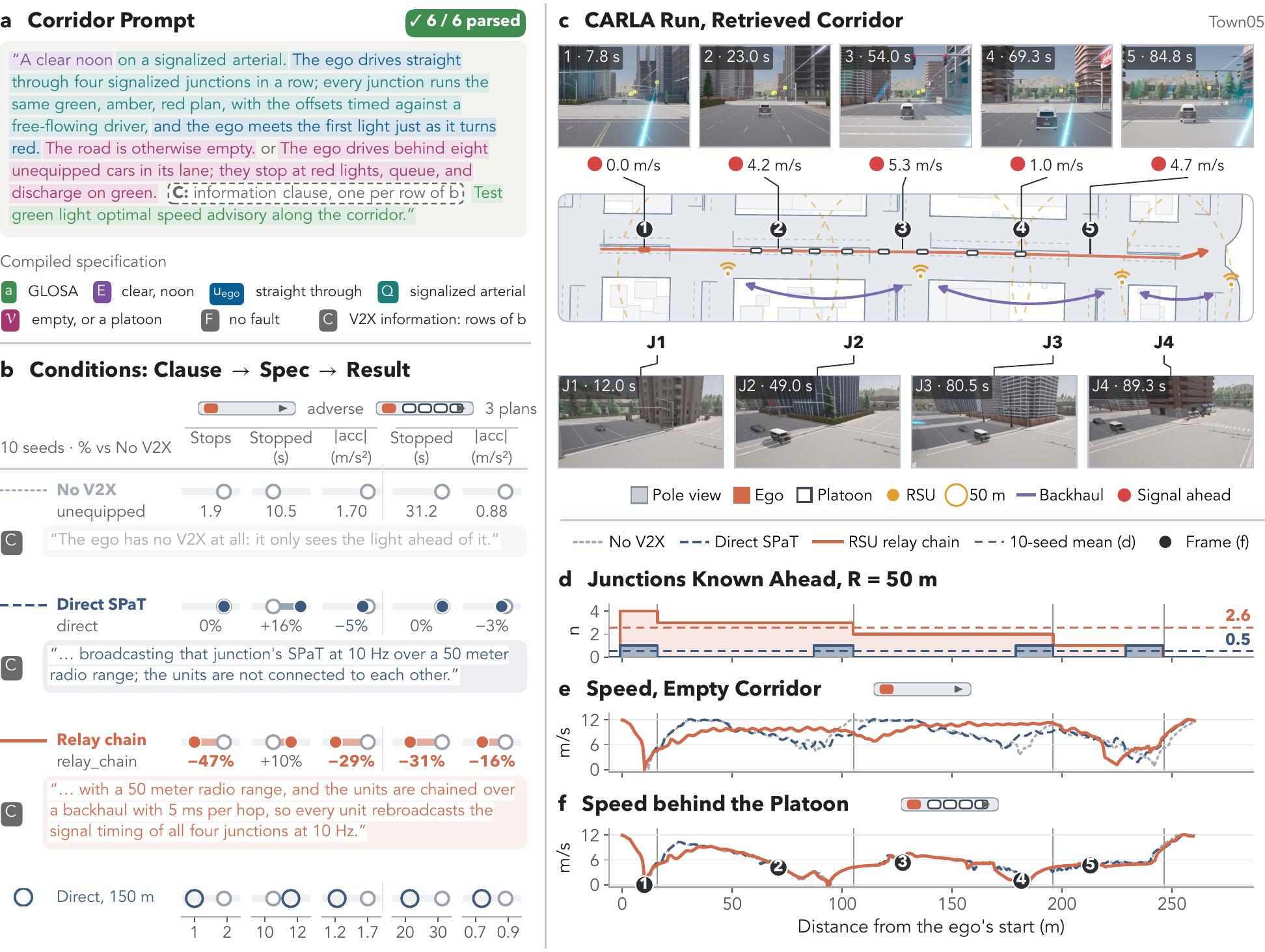
    0.5 → 2.6 junctions known ahead stops 1.9 → 1.0 420 runs, 0 collisions
    Corridor traversal along an RSU chain.
    Figure 6. One prompt, three information clauses: no V2X, direct SPaT and an RSU relay chain.

    Cooperation can be measured, and it only works when both vehicles are equipped.
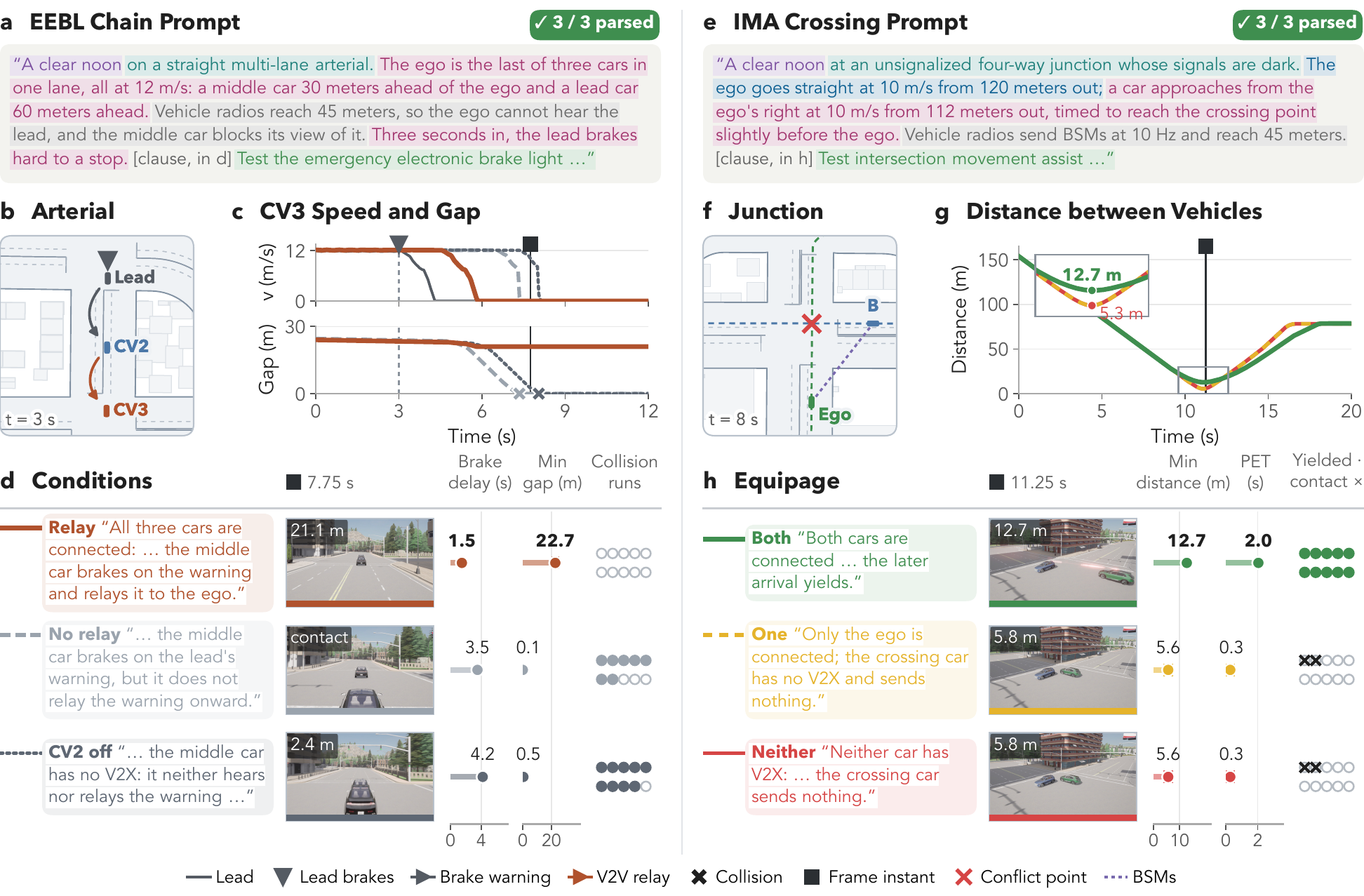
    EEBL relay: 7/10 → 0/10 crashes IMA: clean yield in 10/10 seeds
    Multi-CV cooperation: EEBL relay chain and IMA mutual yield.
    Figure 7. EEBL V2V relay chain (a–d) and IMA mutual yield (e–h), 10 seeds per condition.

    6Citation

    BibTeX

    @misc{wu2026lastv2x,
      author = {Wu, Keshu and Zhang, Hao and Gan, Rui and Li, Pei and Jiang, Jiwan and Zhou, Yang},
      title  = {{LAST-V2X}: Language-Driven Adaptive Scenario Synthesis and Testing for
                Communication-Induced Failures in {V2X} Safety Applications},
      year   = {2026},
    }

    Previously released as V2XSynth.